The joy of Le Déhus
Over the last few weeks there has been a lot of coincidences and synchronicity in my life, and I know I am not alone.
Yesterday was 12th August, new moon and significant solar eclipse.
One of my beautiful dedicated practitioners is on holiday near Carnac - a major Neolithic centre in Brittany - and she sent to me photos of her girls at the various stones near where they are staying. She also sent me a link to an article, this article actually, all about Le Déhus dolmen here on Guernsey.
Unbeknown to her, I had spent that early morning in Le Déhus watching the rising flood do its thing in the dolmen, with my stone friend.
It’s funny. When I met my stone friend, in a dolmen that spring equinox, and I asked him what his favourite dolmen is on the island he told me, “Le Déhus”. “How could it not be?”, was most likely his next comment, because this is the most famous of the local dolmens on account of the rock art on the ceiling, which finds the dolmen locked over night so that it can’t be vandalised.
At that time, I didn’t feel similarly. I was very much into La Varde with its sublime winter solstice light show and goddess carvings, and didn’t like the fact the Déhus had been restored and essentially “messed with”, and there is something about the rock art which seems so out of context from the softer, more goddess-like approach in the other dolmens.
It is a dolmen though, that has stood the test of time and I do have a soft spot for such places as they usually have significant power, so I should have given it the benefit of the doubt.
The story goes that the dolmen - which is situated in Vale - was saved from destruction in 1775 when John de Havilland bought the monument and surrounding land for £4.50 to protect it from being destroyed for building materials by local quarrymen.
Archaeologist, Frederick Corbin Lukis, led a major excavation of the tomb from 1837 to 1847, which uncovered ancient pottery, a copper dagger and human remains dating from (so they believe) 3500 to 2000BC.
Later it was acquired by the States and it underwent major restoration during the 1930s giving it its current structural layout. In particular, the restoration tried to protect the so called Guardian of the Tomb, a rare prehistoric rock carving of a bearded face with hands and a bow on the underside of a capstone.
I might say that the dolmen called me to it.
I had become increasingly immersed in the Neolithic landscape, visiting Isle of Lewis, Orkney and Carnac by then, as well as spending many an evening and early morning in the local dolmens, especially the ones on the west coast so I was aware of their solar alignments.
Then something made me curious about Le Déhus and somehow I connected with our local archaeologist who was happy to grant me early morning access so that I could start testing my theory about potential solar alignments.
I had a hunch the sun would flood the passage way on Beltane, on 1st May, a day especially celebrated in Ireland. This is when earth’s energies are at their most potent and fertility is a key theme - think maypoles as a phallic representation of the penis. It was a night that people of olden times celebrated with dancing and merriment, and were said to enjoy sex out in the meadows, as the dawn approached.
I wasn’t wrong. It was magical. Quite a light show. The shadow from some of the inner menhirs creating penetrating shadows into the back stones of the dolmens. Phallic indeed. My stone friend was in Ireland at the time, and said it might have been the first time for a long time that the dolmen had received sunlight on its sun aligned date. I was on a high for hours.
Since then I have returned each Beltane and in early August too, around Lammas, to gift the dolmen its solar boost and maybe because of this, the dolmen has been very kind to me and each time I visit, it reveals something new. We have developed a deeper connection because of all this and I can honestly say that it is probably now my favourite dolmen, it feels forgiving and ever so loving - and very powerful too.
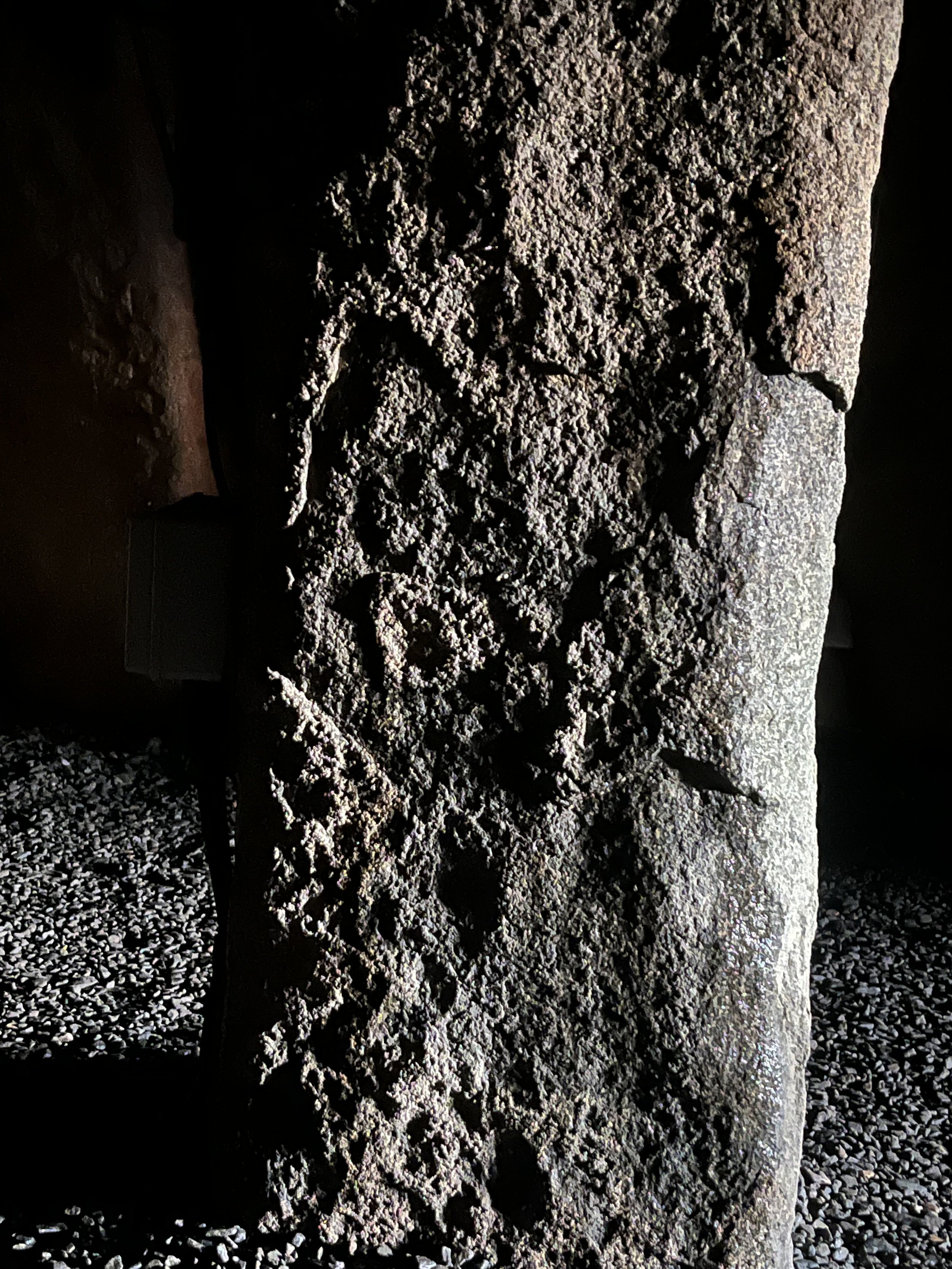
When I visited for Lammas this year, I dowsed as I always do to enter the passageway, and I asked the rods to show me where to sit. I was to sit to the side of the central stone, which Martyn (in his article, link above) says delimits East/West, and because of the pre-dawn light I was able to notice rock art I had never seen previously.
The ancients were really into the inter-play of light and shadow and it is only in certain ‘lights’ that one can see the rock art - they were very clever that way. Part of their mystery is that there is always more to the place than one can initially see and it is only by spending time in them that you begin to ‘see’ beyond the ordinary.
Plus they work with symbols as ancient cultures usually did. Words are often limited and loaded, while symbols cuts through this, so that we can understand a place on a deeper level - without the mind getting so involved.
I found myself there yesterday (12 August) because my stone friend had been finessing the dates, and had a sense the alignment might be more potent, on 12 August, and he was right. More rock art was revealed to us.
So I was curious then, when I arrive home and logged on, there in my inbox sat the email from my lovely student all about the Déhus. And on the day of the new moon and the solar eclipse too. Weird.
I don’t believe know that I agree with what Martyn says about the dolmen being centred on Easter or God for that matter, given that the Neolithic’s were part of a Goddess culture, as we can see so clearly elsewhere on the island - look at those two incredible carved Goddesses at St Martin’s church and Castel church, to say nothing of the sculpted breast and belly and Goddess carving in La Varde, and the quite clear yoni in the Cruex.
I can’t comment on his reference to Orion, as I’d need to start observing sunrise in the passage way more regularly during the winter months, but many people talk about the connection between Orion and Neolithic stones, so maybe there is some truth in it. Only time will tell. I’m now curious.
I am aware though, that for all our calculations and all our observations, no one can ever say with absolute certainty that they have “got it”. when it coms to the Neolithics. Because the Neolithics were very clever and there is always much more than we see with our eyes or understand with our Western educated minds. And this is what I love the most about the stones really, is that they shall always remain part mystery - and in many ways this is their magic, because there is always possibility.
What I love most though, is the relationship we build with the stones, how they reveal parts of themselves to repeatedly draw us back to them. They want to be used. So I am grateful to Martyn for raising awareness of Le Déhus, but I am very much opposed to his idea of commodifying it and capturing it inside our existing capitalist paradigm.
How can one truly put a price on visiting a sacred site like Le Déhus. The joy of our Neolithic landscape here on Guernsey, is that we can immerse in it for free and at our liberty. It would be a real shame if we had to pay to visit and couldn’t just enjoy the space, quietly, and allow it to change us, as it will do, if we spend time in it.
I hope you all enjoyed the eclipse. I felt the spiral shift, anticlockwise, which was a really strange feeling, just as it peaked. Time has slowed down for me since then - anyone else noticing the shift?
Love Emma x